Carbon Neutral Shipping | Free shipping for orders of £200


Views: 0 Author: Site Editor Publish Time: 2026-05-29 Origin: Site


If you watch professional sports today, you will notice a distinct trend on the faces of top-tier competitors. From endurance runners and elite cyclists to tennis champions and HIIT athletes, more professionals now wear Nasal Strips during maximum-effort events. This rising visibility raises valid questions about their actual physiological benefits. Are they a marginal gain, or just another sports fad?
The core problem athletes face is straightforward. Traditional pharmacy sleep strips often fail under the extreme stress of high-impact movement and heavy perspiration. When you sweat profusely, standard adhesives dissolve, and the strip peels away. You lose the airway support exactly when you need it most. Furthermore, the tension required to hold open an athlete's airway during heavy breathing far exceeds what a basic bedtime strip provides.
This article provides an objective, evidence-based evaluation of sport-specific, drug-free nasal dilation tools. We will filter out the marketing noise to uncover the proven physiological and mechanical benefits. You will learn how they work, what the clinical data actually proves, and how to choose the right system for your specific training needs.
Mechanical, Not Chemical: Athletic nasal strips provide drug-free airway expansion by physically preventing the nasal valve from collapsing under high negative pressure.
Realistic Performance Gains: Clinical evidence shows a measurable decrease in airflow resistance (up to 10%), which primarily lowers *perceived* exertion rather than directly altering cardiovascular capacity (VO2 max).
The Sport-Specific Difference: True athletic strips differ from pharmacy sleep strips in three areas: medical-grade sweat-resistant adhesives, higher spring tension, and occasionally magnetic structural designs.
Implementation Caution: Proper skin preparation and removal protocols are critical to avoid skin shearing or acne over repeated training blocks.
To understand why these devices exist, we must look at human respiratory anatomy. The nasal valve acts as the narrowest point of your entire airway. When you breathe softly at rest, air passes through this valve without issue. However, when you exercise, your breathing velocity increases dramatically.
This rapid airflow introduces the Bernoulli effect. As the velocity of a fluid or gas increases, its pressure decreases. Inside your nose, this high-speed airflow creates negative pressure. The negative pressure pulls the soft tissues of the nasal walls inward. Eventually, the walls collapse, effectively choking off your nasal airway. You are then forced to switch entirely to mouth breathing.
Sport-specific Nasal Strips combat this exact physiological mechanism. They act as external scaffolding for your nose. By adhering firmly to the exterior skin and bridging across the bridge of the nose, they physically lift the nasal side walls. This counteracts the negative pressure. The valve remains open, allowing a continuous, unobstructed flow of air even during heavy exertion.
You cannot grab a standard sleep strip from the pharmacy and expect it to survive a grueling track session. True athletic variants engineer two specific components differently:
Tension Level: Standard strips use thin plastic bands. Athletic strips require thicker embedded plastic splints or robust structural ribs. They need higher spring tension to maintain airway dilation during aggressive mouth-and-nose breathing.
Adhesive Profile: Bedtime strips use gentle adhesives meant for cool, dry rooms. Athletic strips utilize aggressive, sweat-proof, medical-grade adhesives. They must perform in high-humidity environments and survive immense facial perspiration.
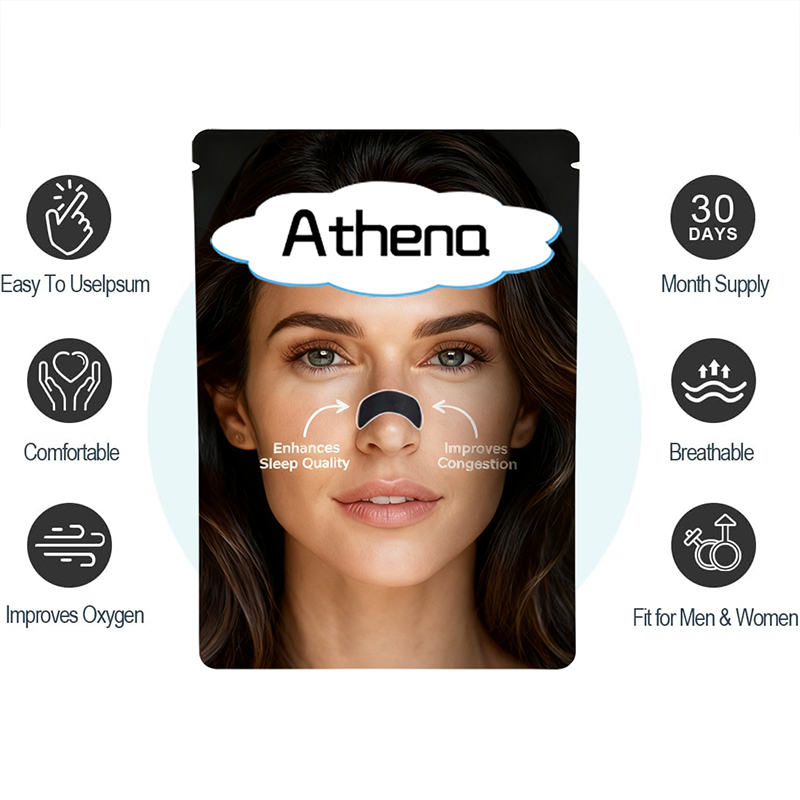
Marketing campaigns often imply that better breathing equals instant cardiovascular superiority. We need to look at the clinical evidence. Reviews of physiological data demonstrate they do not statistically increase maximal oxygen uptake (VO2 max). They also do not fundamentally alter your heart rate during max exertion. Your lungs, heart, and cellular mitochondria dictate your absolute oxygen processing limit, not the diameter of your nostrils.
While they do not boost your VO2 max, they do offer genuine mechanical benefits. Testing frameworks using airflow perturbation devices reveal concrete data. These clinical devices confirm that wearing a nasal dilator measurably decreases bilateral nasal resistance by approximately 10%.
Clinical Testing Chart: Airflow Perturbation Device Results | |||
Breathing Metric | Baseline (Without Strip) | Active Use (With Strip) | Measured Difference |
|---|---|---|---|
Average Nasal Resistance | ~5.5 cm H2O/Lps | ~5.0 cm H2O/Lps | 10% Reduction |
Inhalation Friction | High during exertion | Significantly lower | Smoother air intake |
Exhalation Friction | High during exertion | Significantly lower | Faster CO2 venting |
If VO2 max remains unchanged, why do elite competitors use them? The true athletic value lies in reducing perceived exertion. Dyspnea is the medical term for the subjective feeling of breathlessness or air hunger.
When you reduce airflow resistance by 10%, breathing feels significantly easier. You expend less energy fighting respiratory friction. Delaying the psychological fatigue associated with breathlessness allows you to push harder and sustain efforts longer. It serves as a tangible, structurally supported placebo effect. You feel more comfortable, so you perform better under stress.
The sports market generally divides non-chemical nasal dilators into two distinct structural categories. Each category offers unique mechanical advantages and specific drawbacks.
These are the familiar, single-use flexible bands utilizing a reinforced spring-action mechanism. You peel the backing, stick them across your nose, and the plastic splints attempt to straighten out, pulling your nasal walls open.
Pros: They present a lower barrier to entry. Application is highly familiar. They are exceptionally portable—you can easily keep a few in your running belt. If one fails mid-event, you can replace it instantly.
Cons: Even "extra strength" sports adhesives can lose integrity during extreme sweating. Furthermore, daily use drives up recurring costs significantly over a training season.
This is a newer innovation in the athletic space. You place small adhesive steel or magnetic tabs on the outside of each nostril. Then, you apply a reusable, rigid magnetic bridge over your nose. The bridge magnetically snaps to the tabs, physically pulling the nostrils open.
Pros: They provide unyielding tension regardless of how much you sweat. The bridge never loses its pull. They are potentially more sustainable over a long training lifecycle since you only replace the small adhesive tabs. This completely eliminates mid-workout peeling.
Cons: They require a higher initial investment. Application demands precise facial alignment for the magnets to engage correctly. Some athletes find the heavier physical footprint of the rigid bridge distracting on their face.
Not all sports dilators perform equally. When selecting a product for your training block, evaluate brands against four crucial criteria.
A sports strip is entirely useless if it slides off your face at mile three. Assess the type of adhesive used by the manufacturer. Look for hypoallergenic, medical-grade, and PFAS-free glues. A reliable athletic product must survive a two-hour high-perspiration threshold without the edges curling or lifting.
Using industrial-strength glue on delicate facial skin introduces risks. You must evaluate the potential for contact dermatitis. Repeated use can easily cause redness, irritation, or breakouts. Always look for brands prioritizing latex-free and non-comedogenic materials. These materials prevent clogged pores and severe allergic reactions during heavy sweat sessions.
Anatomical fit determines mechanical success. If you use a device that is too short, the tension bands will not reach the target tissue above the nasal flare. It will simply squeeze the bridge of your nose. Conversely, if it is too long, the ends will overlay your cheek creases. When you smile or grimace, your facial movements will compromise the adhesive seal, causing instant failure.
Assess the economic viability of your chosen system based on your training volume. Traditional single-use models are typically priced higher for the "extra strength" sport tier. If you train six days a week, these costs compound rapidly. Compare this against the long-term return on investment of magnetic bridge systems, where replacement tabs cost fractions of a premium full-size strip.
Measure the width of your nose before purchasing. Many brands offer sizing templates online.
Test your chosen size during a low-intensity workout first to ensure the edges do not lift.
If you have a wider nasal bridge, avoid standard sizes; they will pop off under their own tension.
Athletes frequently abandon nasal dilators because they apply them incorrectly or suffer skin damage upon removal. Proper protocols solve these issues entirely.
Skin preparation dictates adhesive success. You cannot simply slap a device onto an unwashed face. You must follow strict skin-prep protocols. Wash your nose thoroughly with an astringent or an alcohol wipe. You need to remove all sebum, natural skin oils, moisturizers, and sunscreen from the application area. Applying an adhesive over oils guarantees mid-workout failure.
Placement is an exact science. The optimal position is just above the flare of the nostril. If you place it too low, it pinches the nostrils closed. If you place it too high on the hard nasal bone, no expansion can occur because bone does not flex. You must target the soft cartilage of the nasal valve.
The most common negative outcome of using high-tension athletic adhesives is skin tearing. You should never rip them off like a standard bandage. You must dissolve the high-strength adhesive matrix safely.
Wait until your post-workout shower. Let warm water saturate the device for several minutes.
Alternatively, soak a cotton pad in micellar water or baby oil and hold it over the adhesive edges.
Gently roll the edges inward toward the center of your nose. Do not pull upward or outward.
The Quick Rip: Tearing the band off dry skin strips away the top dermal layer.
Sunscreen Underlap: Failing to clean sunscreen off the nose before application.
Re-sticking: Peeling it off to adjust placement and expecting it to hold during a workout.
Drug-free nasal strips serve as a low-risk, high-comfort optimization tool for dedicated athletes. They will not magically replace your foundational cardiovascular fitness, nor will they inflate your VO2 max. However, they effectively remove a noticeable layer of respiratory friction. By decreasing nasal resistance by up to 10%, they reduce the psychological burden of breathlessness, allowing you to sustain focus and power output during high-intensity efforts.
As a next-step action, athletes should avoid using a new breathing system for the first time on race day. Trial a starter pack of both a high-tension adhesive strip and a magnetic system during moderate-intensity "Zone 2" training. Observe how your skin reacts to the adhesive and determine which structural design best accommodates your specific facial anatomy before utilizing them in a maximum-effort scenario.
A: Yes, but caution is advised due to the aggressive adhesives used in sport variants. These heavy-duty glues may cause morning skin irritation or contact dermatitis if worn for 8+ hours nightly. Standard, gentle strips are vastly better for chronic, everyday sleep use.
A: No. Humans naturally transition to oro-nasal (mouth and nose) breathing under high aerobic demand. Strips optimize the nasal portion of this dual-pathway intake to maximize air volume, but they absolutely do not force nasal-only breathing during maximum exertion.
A: Yes. Because they are entirely mechanical and drug-free—containing no corticosteroids, stimulants, or decongestants—they are compliant with global anti-doping regulations. They are widely permitted in professional tennis, cycling, running, and all major team sports.


